
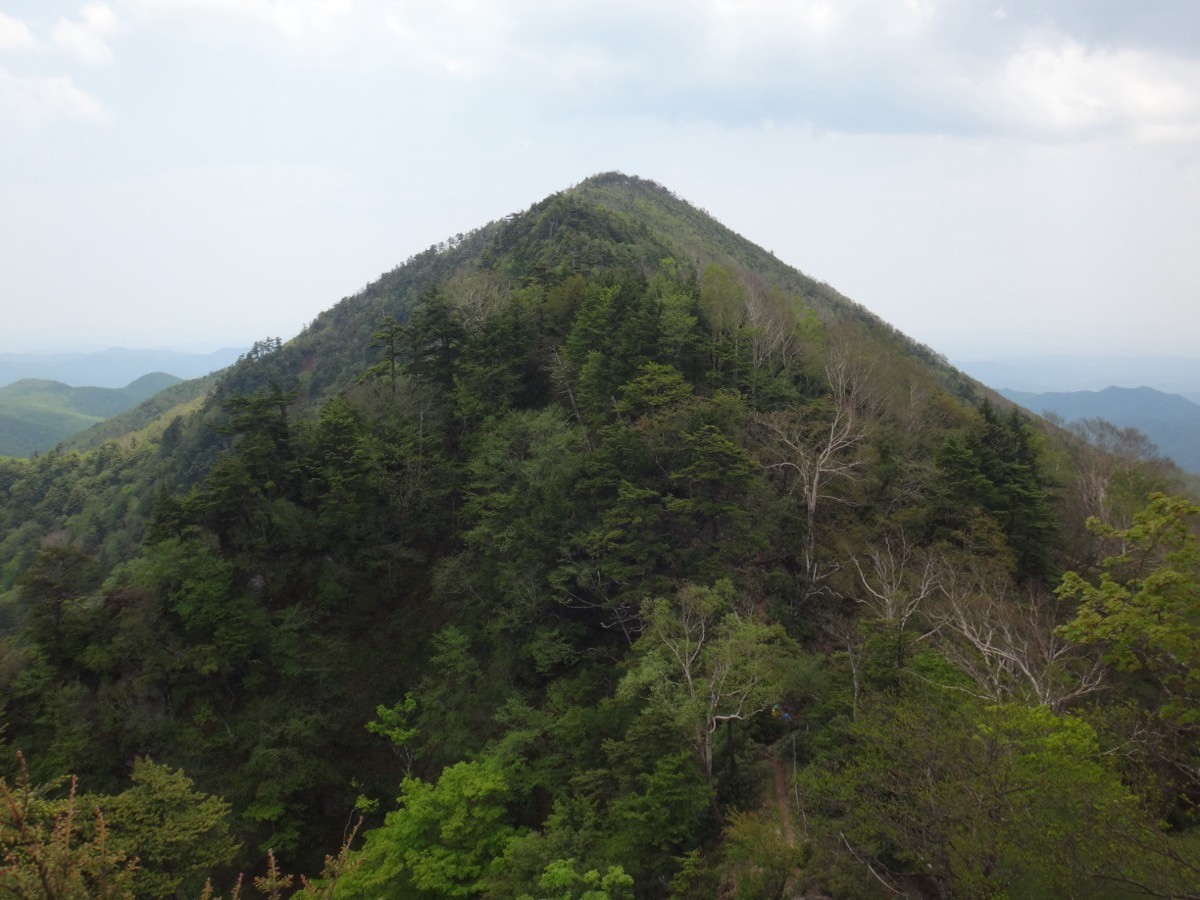
Mount Kesamaru (Kesamaruyama, 1,878 m at the front peak) sits on the border of Midori City in Gunma and Nikko City in Tochigi, and is one of Japan’s 300 Famous Mountains.
A peak of the Kesamaru range that continues to Mount Sukai in the Ashio Mountains, its appeal lies in the great colonies of Akayashio azalea that turn the slopes pink in May and relics of mountain faith such as the reclining Buddha and Sai-no-Kawara. The main route is an out-and-back from the Oriba trailhead via Tsutsuji-daira and Komaruyama to Mae-Kesamaruyama, an intermediate course.
Public transport to the trailheads is limited, so you reach them by combining a taxi from Sawairi Station on the Watarase Keikoku Railway.
The main trailheads are Oriba (free parking for 25–30 cars) and the Tonosawa trailhead, which has the reclining Buddha. The main route is Oriba trailhead → Tsutsuji-daira → Sai-no-Kawara → Komaruyama → Mae-Kesamaruyama (1,878 m) and back, about 6 hours of walking, an intermediate route. From the ridge there are views of Mount Sukai, Mount Nantai and the Nikko peaks.
The best season is spring to autumn (May–October), with the Akayashio azalea at its best from around Golden Week to mid-May. Always check the latest trail conditions and arrange a taxi before you go.
*Last checked: June 7, 2026
How to access the trailheads
1. [There & Back] Sawairi Station ⇄ Oriba / Tonosawa trailhead (Watarase Keikoku Railway + taxi)
Sawairi Station on the Watarase Keikoku Railway is your base. There is no direct bus to Mount Kesamaru, so combine a taxi from the station.
① Sawairi Station → Oriba trailhead (taxi)
Change to the Watarase Keikoku Railway at Kiryu Station on the JR Ryomo Line and get off at Sawairi Station. From there it is about 12 km, around 35 minutes by taxi, to the Oriba trailhead. This is the popular trailhead for the azalea and the main ridge.
② Sawairi Station → Tonosawa trailhead (taxi)
From Sawairi Station the Tonosawa trailhead is the nearest, about 4.8 km and 15 minutes by taxi; this route passes the reclining Buddha on the way to the summit.
— Numataya Taxi 0120-08-5242. As Sawairi is in the mountains, booking a taxi in advance is reliable.
③ Note (frequency and season): the Watarase Keikoku Railway has few trains, and the azalea season (May) is busy with hikers. Check the latest train times and arrange your taxi in advance.
By car: there is free parking (25–30 cars) at the Oriba trailhead. Access from the Isesaki IC on the Kita-Kanto Expressway via National Route 122.
References: [Midori City Tourism: Mount Kesamaru] / [Watarase Keikoku Railway]
Trail Guide and Safety Notes
Route: the main route is an out-and-back from the Oriba trailhead via Tsutsuji-daira, Sai-no-Kawara and Komaruyama to Mae-Kesamaruyama (1,878 m), about 6 hours of walking, an intermediate route. Beyond the front peak, the way to Ushiro-Kesamaruyama and the highest point (1,961 m) has more rock and brush and is for experienced hikers.
Weather and difficulty: the ridge has fine views but is exposed to strong wind and mist, and the latter part has narrow ridges and steep slopes. Snow lingers late, so mind your footwear in the late-snow season. It is Asian black bear and monkey country.
Views and flowers: from the ridge there are wide views of Mount Sukai, Mount Nantai and the Nikko peaks. The Akayashio azalea in May colours the slopes from Tsutsuji-daira, and the Tonosawa route keeps relics of faith such as the reclining Buddha and Sai-no-Kawara.
Equipment and emergencies: carry rain gear, warm clothing, a headlamp, a map/GPS, plenty of food and a bear bell. In an accident or emergency call 110 (police) or 119 (fire/ambulance).
・Kiryu Police Station 0277-44-0110
Photo by Koda6029 / Wikimedia Commons, CC BY-SA 4.0
Comments