Kyushu(九州)
Kyushu(九州) has 24 mountains you can reach using only public transport — trains and buses. 6 of them are among Japan's 100 Famous Mountains. Popular choices include Mt. Aso, Mt. Kaimon, Mt. Kirishima and Mt. Kujū. Each guide shows the route from the nearest station to the trailhead, with up-to-date bus timetables.
Browse by prefecture: Kagoshima(鹿児島) (3), Oita(大分) (2), Fukuoka (1) and Kumamoto(熊本) (1)
Mountains in Kyushu(九州) — Map
Compare by the numbers
The highest peak in the Kitakyushu area, known for its 360-degree view to the Hibiki Sea and for spectacular New Year's sunrises.
The dominant peak of the Sobo-Katamuki range in Kyushu, mantled in primeval forest and Akebono azaleas with a superb summit view.
The highest peak in Kyushu on UNESCO World Heritage Yakushima, condensing diverse vegetation zones and granite wonders into one climb.
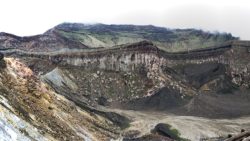
An active volcano with one of the world's largest calderas, offering dramatic views of the Nakadake crater and Kusasenri grassland.
One of Japan's three Hikosan sacred peaks, a triple-summit mountain long used for Shugendo practice with spectacular autumn color.
One of the anchors of the Kyushu highlands, combining ancient Ichifusa cedar giants lining the approach with sweeping central Kyushu views.
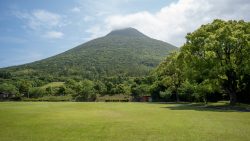
The Satsuma Fuji rising sharply from the sea, whose spiral trail delivers views stretching to Sakurajima and Yakushima.
The highest peak of the Kirishima chain, an active volcano with a massive 900-meter crater and views of Ebinokogen and Lake Onaminoike.
A sharp peak in the Sobo-Katamuki range with three rock towers and a relentless sequence of chains and ladders on the Bōzu Ridge.
A southern Kyushu volcanic cluster fragrant with myth, celebrated for Miyama Kirishima azaleas, crater lakes, and hot-spring villages.
A vast volcanic cluster harboring Kyushu's mainland highest peak, celebrated for Bogatsuru wetland, Miyama Kirishima azaleas, and autumn color.
The last great wilderness of Kyushu, dominated by the towering Wakutsuka granite towers whose sheer scale is breathtaking.
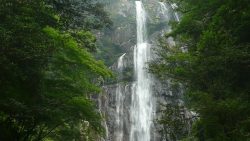
A mountain whose greatest draw is a cascade corridor of more than 30 falls, the first scenic site ever designated in Japan.
An active volcano whose grandeur is best experienced from the Yunohira Observatory, set against the sweeping panorama of Kinko Bay.
A Yakushima peak where the moss-draped ancient cedar forest gives way to the spectacular 40-meter monolith called Tenchūseki.
The eastern anchor of the Kujū range, whose Miyama Kirishima azaleas and autumn foliage ring the volcanic crater lake Oike.
The sacred peak of the Divine Descent myth, a perfect cone topped by the reversed spear Ama-no-Sakahoko, speaking of ancient legend.
The highest peak of the Ōsumi Peninsula, with a summit shrine and a ridge-top view stretching to Sakurajima, Kinko Bay, and Kaimonodake.
A sacred Shugendo mountain in Kyushu with the Kinsenjī temple deep in the forest, spring Shakunage, and views across the Ariake Sea.
An active volcano rising behind Beppu Onsen, waiting with a 360-degree view of Beppu Bay, Yufudake, and the Kujū range.
A Nagasaki volcano where the summit of Fugendake delivers a close view of the Heisei-era lava dome born from eruption.
The tidy grassland Kusu Fuji of Oita, prized for a panorama of the Kujū range and Aso, with hot-spring villages close at hand.
The Bungo Fuji, a twin-peaked volcano looming above Yufuin Onsen, with sweeping views of the Yufuin Basin from the east summit.