
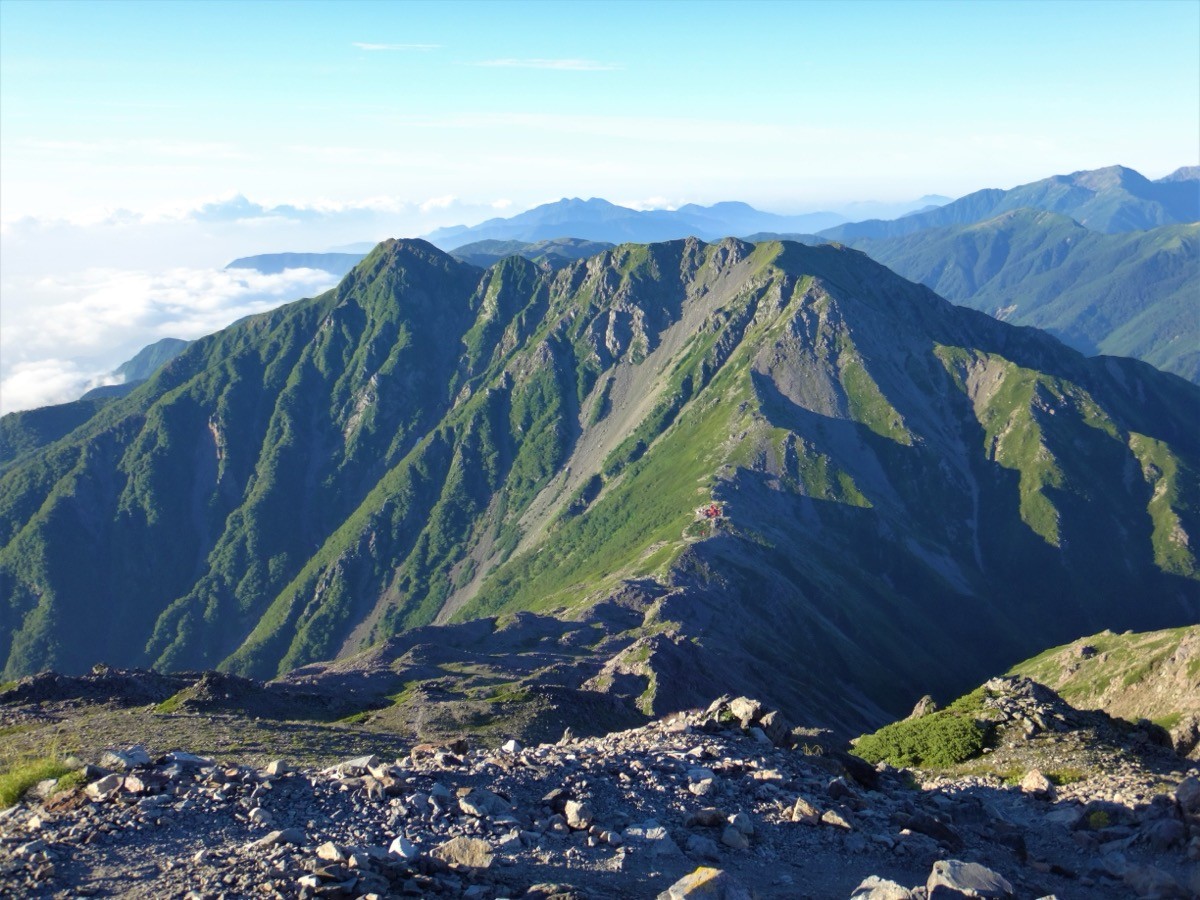
Mt. Notori (農鳥岳, 3,026 m), on the border of Hayakawa in Minamikoma, Yamanashi and Aoi Ward in Shizuoka City, is one of the 200 Famous Japanese Mountains.
A high peak at the southern end of the Shirane Sanzan with Mt. Kita and Mt. Ainodake, its appeal is the magnificent 3,000 m ridge continuing from Mt. Ainodake and the grand view to Mt. Fuji and Mt. Shiomi. It is usually climbed up Daimon-sawa from Narada, and the classic plan is an advanced route of two or three days with one night at Daimonzawa Hut crossing over Mt. Notori.
For public transport to the trailhead, you can reach Narada by the Hayakawa community bus from Minobu Station on the JR Minobu Line.
The trailhead is the Narada Daiichi Power Station (Daimon-sawa trail entrance, about 840 m), about 30 minutes on foot from Narada Onsen. The standard route is Narada Daiichi Power Station → Daimon-sawa trail entrance → Daimonzawa Hut (overnight) → Daimon-sawa descent point → Mt. Nishi-Notori → Mt. Notori; the first day to Daimonzawa Hut takes about 4–5 hours. With a large elevation gain it cannot be done as a day trip and is an advanced route. Daimon-sawa has fords, log bridges and steady steep climbs, and above the descent point it becomes a rocky ridge above the tree line.
The relay base on the way to the ridge, Daimonzawa Hut, is open from 1 July to 14 October in 2026 (phone reservation only). The best season is July to mid-October while the hut is open; on the 3,000 m ridge beware of lightning, strong wind and sudden weather changes. Always check the latest trail, hut and bus conditions in advance.
*Last checked: June 6, 2026
How to access the trailheads
1. [Round trip] Minobu Station → Narada → Narada Daiichi Power Station (trailhead)
The base is Minobu Station on the JR Minobu Line.
① Minobu Station → Narada Onsen (Hayakawa community bus)
Take the “Hayakawa community bus” run by Hayakawa Town and get off at Narada Onsen. It takes about 1 hour 30 minutes and is reservation-only (book by 19:00 the day before). Large luggage such as a hiking pack costs an extra ¥200.
― Minobu Station dep.: 7:54 / 12:14 / 14:34 / 17:34
― Narada Onsen dep. (toward Minobu): 6:35 / 9:50 / 13:50 / 15:55
Check the operating days and latest times with Hayakawa Town’s official guide.
② Narada → Narada Daiichi Power Station (trailhead)
From Narada Onsen to the Narada Daiichi Power Station, where the Daimon-sawa trail begins, is about 30 minutes on foot. In the summer season (26 June to 3 November in 2026) the Southern Alps forest-road bus between Narada and Hirogawara also runs and you can get on or off near the power station (user cooperation fee ¥300 each way per person).
Inquiries: For the latest bus and forest-road information, check with Hayakawa Town Hall (0556-45-2511). If you drive, there is parking at Narada.
Source: [Hayakawa Town, public transport (Hayakawa community bus)] / [Daimonzawa Hut]
Route and safety notes
Route: Narada Daiichi Power Station → Daimon-sawa trail entrance → Daimonzawa Hut → Daimon-sawa descent point → Mt. Nishi-Notori (3,051 m) → Mt. Notori (3,026 m). The first day to Daimonzawa Hut takes about 4–5 hours, an advanced route with one night at Daimonzawa Hut. Beyond the descent point it is a 3,000 m ridge walk with grand views of Mt. Ainodake, Mt. Shiomi and Mt. Fuji.
Steep climb and fords: Daimon-sawa is a stamina-testing path with fords, log bridges and a long, steep climb. The fords become dangerous in high water, so take particular care after rain.
Ridge and weather: Above the Daimon-sawa descent point, the 3,000 m ridge carries a high risk of lightning, strong wind and hypothermia, and escape is difficult. Go with a realistic schedule and proper gear.
Hut and season: You can buy drinking water at the hut. The best season is July to mid-October while Daimonzawa Hut is open; outside it, snow and ice make it unsuitable for general hiking. The hut is phone-reservation only.
― Daimonzawa Hut reservations 090-7635-4244
Emergencies: In an accident or emergency, call 110 (police) or 119 (fire/rescue).
・Minami-Alps Police Station 055-282-0110
Photo by Koda6029 / Wikimedia Commons, CC BY-SA 4.0
Comments