
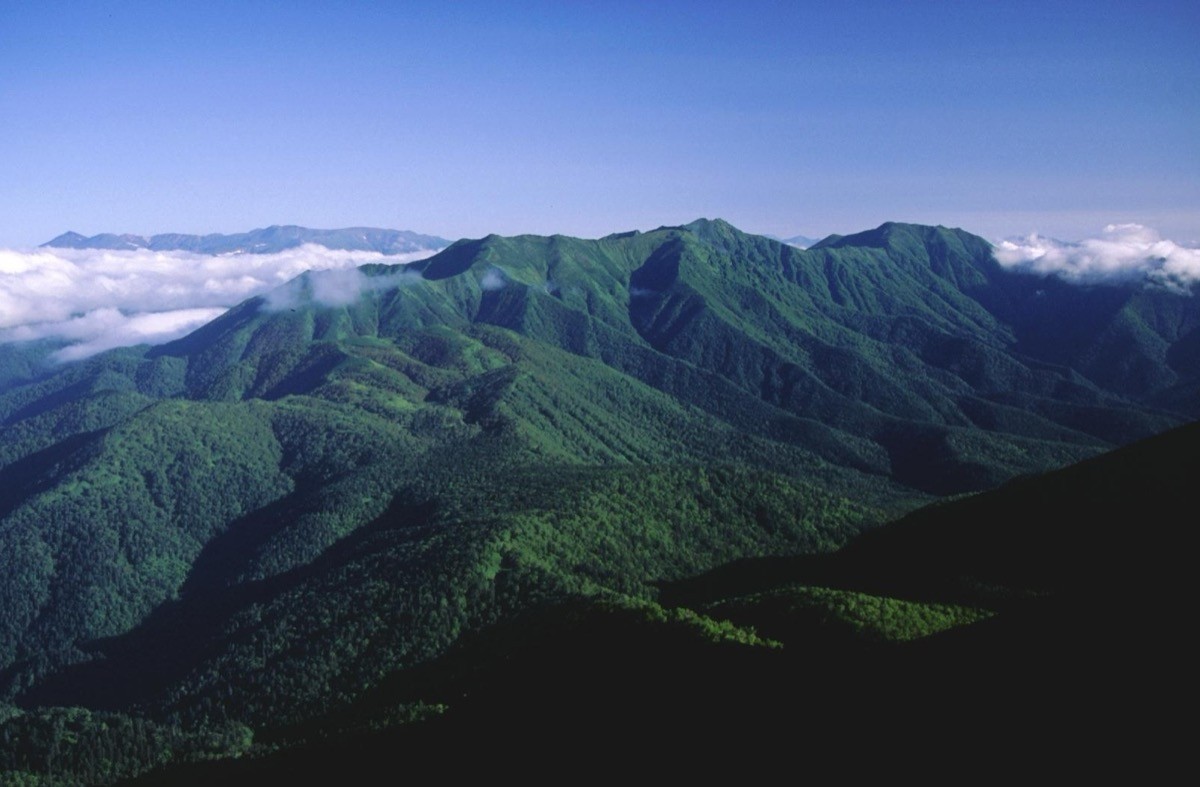
Mt. Ishikari (石狩岳, 1,967 m), straddling Kamikawa and Kamishihoro in Hokkaido, is one of the 200 Famous Japanese Mountains.
The highest peak of the eastern Daisetsuzan range (Higashi-Daisetsu), its appeal is the grand view from the summit over Mt. Nipesotsu, Mt. Tomuraushi and other Daisetsu peaks. The Schneider Course climbs a steep ridge directly and is one of Hokkaido’s toughest ascents, an advanced round trip of about 9–10 hours. It is a fit-hiker’s mountain with many spots where you use your hands.
The nearest base is Nukabira Onsenkyo. There is no public transport to the trailhead, so a rental car and an overnight stay are assumed.
The trailhead is the Schneider Course trailhead (Nijuichi-no-sawa junction on the Otofuke River, parking for about 20 cars, portable toilet). The route runs trailhead → along the stream → ridge start → the crux of the Schneider Course (steep climb) → Mt. Ishikari and back; the standard times are about 5.5 hours up and 3.5 hours down, advanced. There are sections of fallen trees and dense creeping pine, and beyond the birch belt you reach the summit plateau.
It is dense brown-bear country, and solo climbing is not recommended. Take precautions such as a bear bell and go in a group. Many stretches have no mobile-phone signal, and there is no toilet, so carry a portable toilet. Water is the stream early on (boil before use). The season is early July to late September.
How to access the trailheads
1. [Round trip] Nukabira Onsenkyo → Schneider Course trailhead (Mt. Ishikari trailhead)
The public-transport base is Nukabira Onsenkyo. From Obihiro Station on the JR Nemuro Main Line, take the Tokachi Bus / Hokkaido Takushoku Bus Kamishihoro–Nukabira line to Nukabira Onsenkyo (services are few, so check the latest times with Kamishihoro Town and the bus companies).
From Nukabira Onsenkyo to the trailhead there is no route bus, so a rental car (or a chartered taxi) is the norm. Take National Route 273 to Tokachi-Mitsumata, then enter the forest road along the Otofuke River and continue about 10 km west to the Nijuichi-no-sawa junction, the trailhead. The forest road may be closed or washed out, so check conditions with the Kamishihoro Town office in advance. As the route is long and steep, staying the night before at Nukabira Onsenkyo is reassuring.
– Kamishihoro Town Office (forest-road conditions) 01564-2-2111
Source: [Kamishihoro, Kamishihoro–Nukabira line timetable] / [Hokkaido Takushoku Bus]
Route and safety notes
Route: Schneider Course trailhead → along the stream → ridge start → crux of the Schneider Course → Mt. Ishikari. The standard times are about 5.5 hours up and 3.5 hours down, around 14 km, with about 1,250 m of ascent, advanced. The crux is a direct climb of a steep ridge with continuous hands-on sections.
Steep climb and fitness: it is one of Hokkaido’s toughest ascents and demands fitness. There are sections of fallen trees and dense creeping pine, so proceed carefully to avoid losing the route.
Bears and signal: it is dense brown-bear country, so carry a bear bell and avoid going alone. Many stretches have no mobile-phone signal, and there is no toilet, so carry a portable toilet.
Gear and season: the season is early July to late September. Carry water, food, rain gear, warm clothing, a map and compass (GPS), and submit a climbing plan. Water is the stream early on; boil before use.
In an emergency: call 110 (police) or 119 (fire/rescue).
・Kamishihoro Town Office 01564-2-2111
Photo by alpsdake / Wikimedia Commons, CC0
Comments