
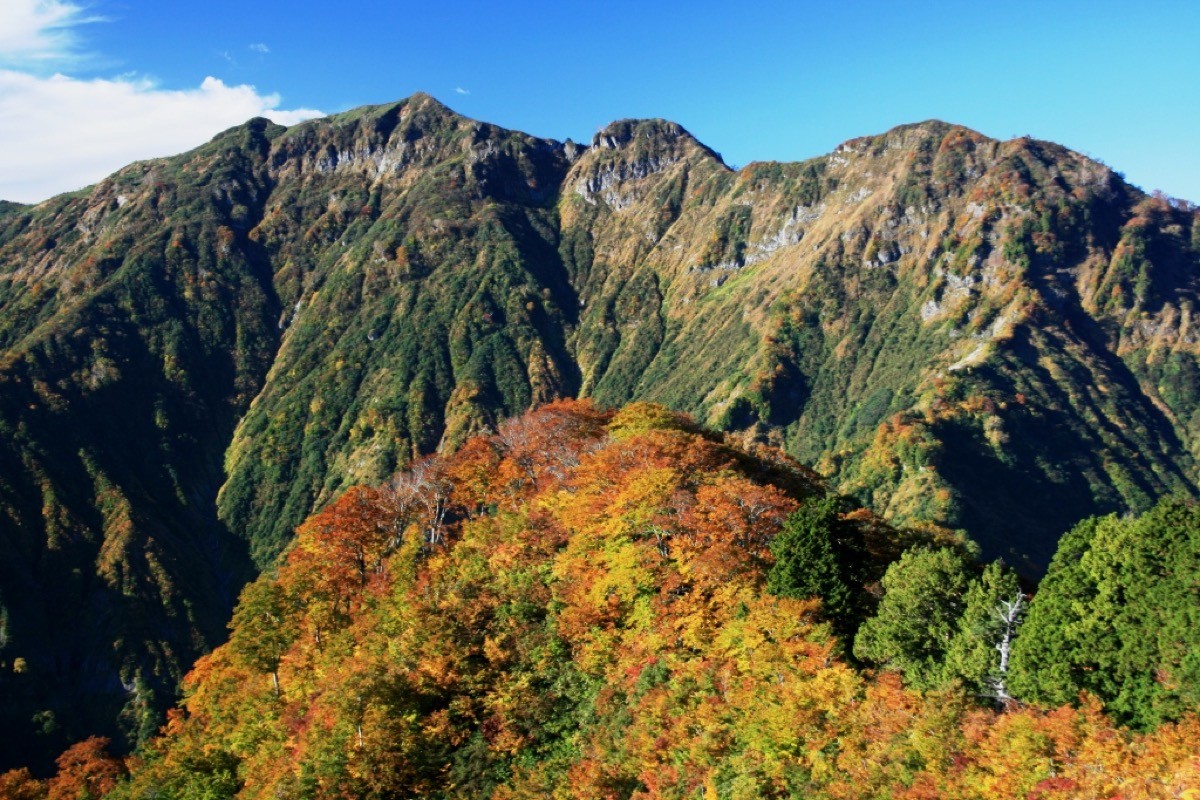
Mt. Oizuru (笈ヶ岳, 1,841 m), on the border of Hakusan in Ishikawa, Nanto in Toyama and Shirakawa in Ono, Gifu, is one of the 200 Famous Japanese Mountains.
A sharp peak of the Ryohaku Mountains north of Hakusan, it is known as a trail-less bushwhacking mountain, one of the hardest of the 200 Famous Mountains, climbed using the residual snow. It can be climbed only roughly from late April to mid-May, during the residual-snow season, and is for advanced climbers only, requiring snow skills, bushwhacking and route-finding.
For the Chunomiya Onsen trailhead, you combine a bus and a taxi (or an inn pickup) from Kanazawa Station.
The trailhead is Chunomiya Onsen (near the Chunomiya Visitor Center, about 700 m). The standard route is up Jirai-dani from Chunomiya Onsen, over Mt. Kamouri and Kamouri-daira to Mt. Oizuru, an out-and-back of about 16 km in the residual-snow season, with over 10 hours of walking, one of the very hardest. There is no proper trail, and in the snow-free season the bushwhacking makes it very hard to climb, so it is usually climbed in the residual-snow season (around Golden Week) when snow covers the slopes. There is also a long route from below the Ichirino Onsen ski area via Mt. Bunao.
The free section of the Hakusan-Shirakawago White Road to Chunomiya Onsen usually opens just before Golden Week (28 April in 2026). Steep up-and-down, cornices, bushwhacking and route-finding are required, so residual-snow experience and gear are essential. Always check the latest road and snow conditions in advance.
*Last checked: June 6, 2026
How to access the trailheads
1. [Round trip] Kanazawa Station → Sena → Chunomiya Onsen (trailhead)
The base is JR Kanazawa Station. There is no direct bus to Chunomiya Onsen, so you combine a bus and a taxi (or an inn pickup).
① Kanazawa Station → Sena (Kaga Hakusan bus)
Take the Hokuriku Railroad (Kaga Hakusan) bus “for Sena” from Kanazawa Station to the terminus, about 1 hour 30 minutes. There are few services, so check the latest times on the Hokuriku Railroad official guide.
② Sena → Chunomiya Onsen (pickup or taxi)
From Sena to Chunomiya Onsen, use an inn pickup (arrange in advance) or a taxi. A taxi straight from Kanazawa Station to the Ichirino/Chunomiya area is roughly ¥12,000. Mobile reception is poor in the residual-snow season, so arrange the return in advance.
― Fuji Taxi (Hakusan-Mattо) 076-276-2210
By car / inquiries: Once the free section of the Hakusan-Shirakawago White Road opens, you can drive to near the Chunomiya Visitor Center. For road and climbing information, check with the Hakusan City Tourism Federation (076-259-5893).
Source: [Hokuriku Railroad] / [Hakusan-Shirakawago White Road]
Route and safety notes
Route: Chunomiya Onsen → Jirai-dani → Mt. Kamouri → Kamouri-daira → Mt. Oizuru (1,841 m), out and back (residual-snow season). It is about 16 km round trip with over 10 hours of walking, one of the very hardest, an advanced route climbing a trail-less bushwhacking mountain in the residual-snow season. From the summit the grand view of Hakusan and the Northern Alps opens up.
Residual snow and no trail: Mt. Oizuru has no proper trail, and the bushwhacking makes it very hard in the snow-free season. Even in the residual-snow season, steep up-and-down, cornices, bushwhacking and route-finding are required, and going solo without snow-mountain experience is dangerous. Going with an experienced climber is strongly recommended.
Season and gear: It can be climbed only roughly from late April to mid-May, in the residual-snow season. Always carry an ice axe, crampons, a map/GPS, warm clothing and spare food, and start and finish early.
Road and emergencies: You cannot reach the trailhead before the White Road opens. In an accident or emergency, call 110 (police) or 119 (fire/rescue).
・Hakusan Police Station 076-275-0110
Photo by Alpsdake / Wikimedia Commons, Public Domain
Comments